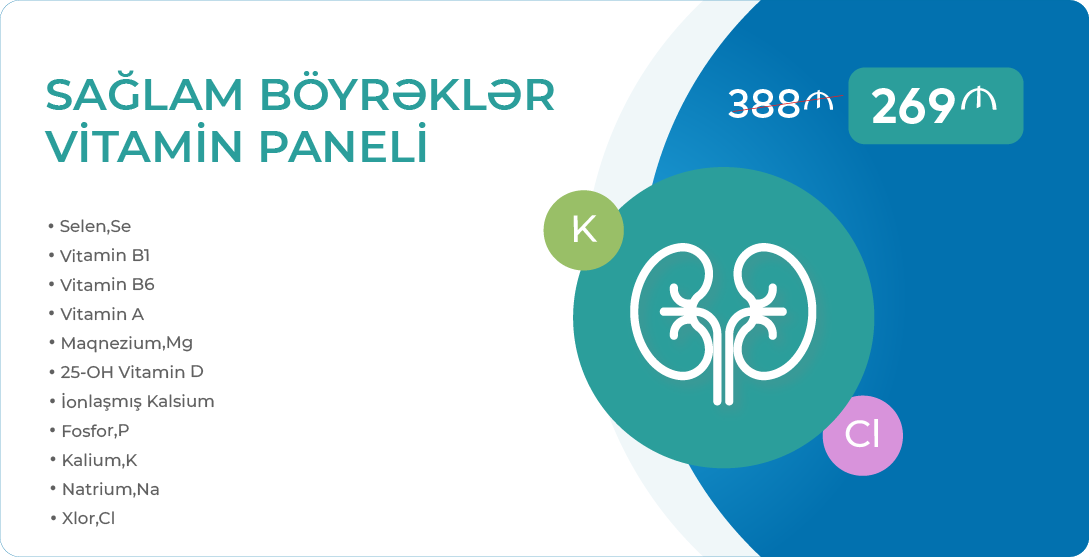
Why is this check-up package important?
Pathological processes occurring in the kidneys lead to metabolic disorders in the body. These disorders, in turn, may cause various vitamin and mineral deficiencies. The following vitamins and minerals are of particular importance for assessing kidney function and monitoring renal health:
Tests included in the check-up package:
- Selenium (Se)
- Vitamin B1
- Vitamin A
- Magnesium (Mg)
- Vitamin D
- Ionized Calcium (Ca²⁺)
- Phosphorus (P)
- Potassium (K)
- Sodium (Na)
- Chloride (Cl)
- Vitamin B6
Vitamin D is first converted into its active form in the liver and then in the kidneys.
- When kidney function is impaired, this conversion process becomes less efficient.
- Excessively high levels of vitamin D can lead to calcium accumulation in the body and may contribute to acute kidney failure.
The kidneys are involved in the breakdown of retinol-binding protein, which transports vitamin A in the blood.
- When kidney function is impaired, this protein is not properly broken down, leading to accumulation of vitamin A in the bloodstream.
- This may result in hypervitaminosis A and toxic effects in the body.
- B group vitamins (B1 and B6)
These vitamins are water-soluble and are mainly obtained through dietary intake.
- Their levels may decrease, especially in patients with kidney disease who have dietary restrictions.
- This deficiency can contribute to increased oxidative stress and cellular damage due to the rise of free radicals.
In patients with chronic kidney disease, serum selenium levels are reduced.
- This deficiency is associated with anemia, muscle weakness, and impaired immune function.
As kidney function declines, the excretion of magnesium becomes impaired, leading to its accumulation in the blood.
- Excess magnesium may cause complications such as low blood pressure, muscle weakness, and changes in mental status.
- Phosphorus and ionized calcium (Ca²⁺)
The kidneys help maintain a balanced level of phosphorus and calcium in the body.
- In kidney disorders, phosphorus cannot be effectively excreted through urine and begins to accumulate in the blood.
- This excess phosphorus draws calcium from the bones, leading to a decrease in bone density.
- As a result, bones become more fragile and the risk of fractures increases.
- Potassium (K), Sodium (Na), and Chlorine (Cl)
The kidneys regulate electrolyte balance and acid–base homeostasis in the blood.
- When kidney function is impaired, the excretion of these substances through urine is reduced.
- As a result, their levels in the blood become imbalanced, which may negatively affect the heart, nervous system, and muscle function.
Online registration is mandatory for check-up examinations. You can contact the Call Center at (+994 55)4000910 WhatsApp or (012) 910 for more information.